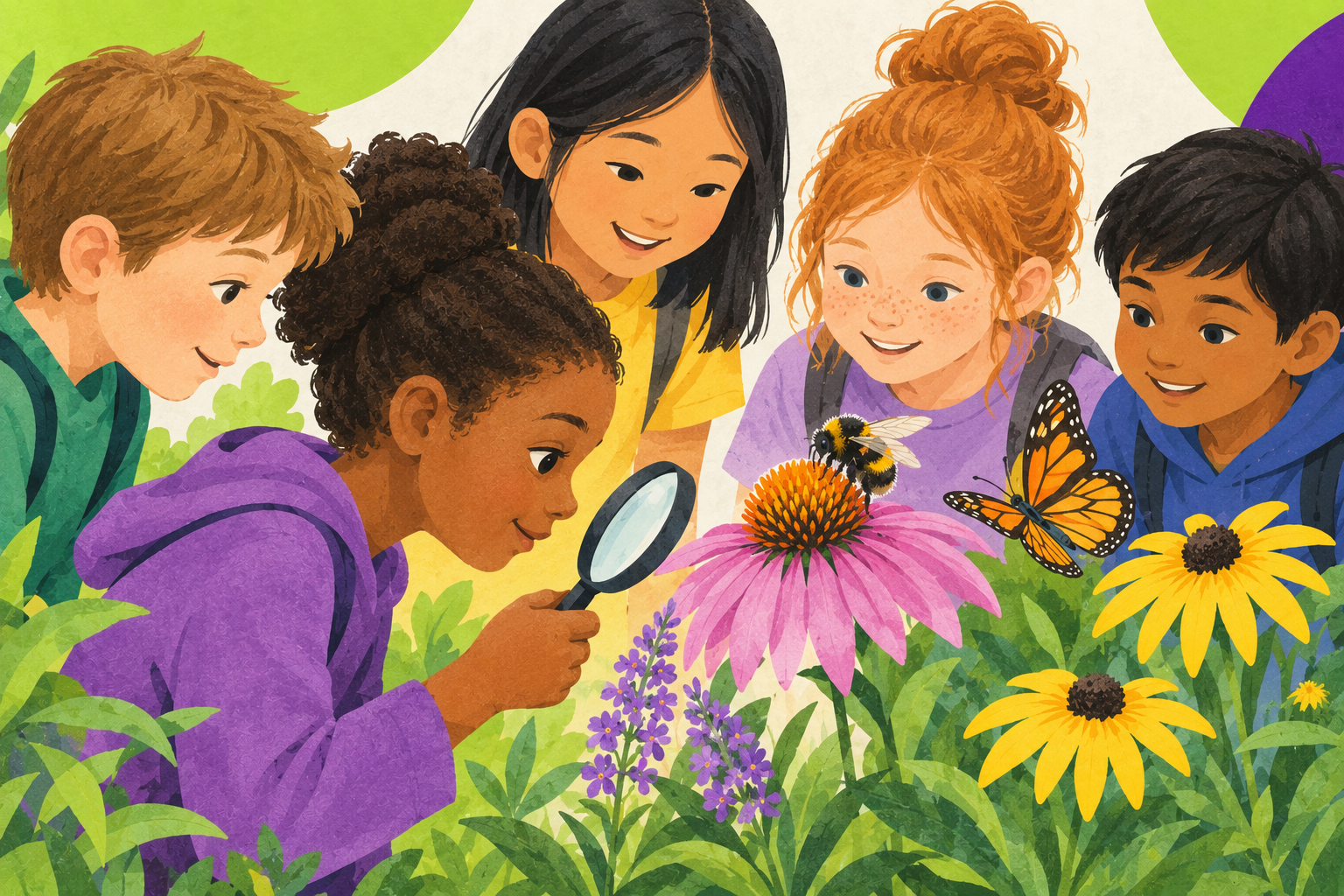
Is taxonomy missing from our teaching — or just hiding in plain sight?
By Dr Lauren Daly & Dr Seb Stroud

Taxonomy is having a moment.

Recent discussions in plant science, and in broader biological disciplines such as entomology and mycology, have highlighted a growing concern: taxonomic expertise is in decline. Fellow BGEN Trustee Dr Seb Stroud and I were recently co-authors on an article about this subject, arguing that this issue doesn’t begin in higher education – and it doesn’t end there either.
Instead, the erosion of taxonomic education runs through the entire educational pipeline. And that raises an important question for us, as a community of botanic gardens and educators:
What role are we already playing in taxonomic education—and what more could we do?
Beyond identification: what are we really teaching?
One of the key challenges is how taxonomy is perceived and taught.
Too often, it is reduced to identification: naming plants, memorising families, learning characteristics. This Latin-heavy task can feel daunting and outdated to our audiences (at times even to us educators) – despite the fact that an average three-year-old can confidently say Tyrannosaurus rex without batting an eyelid…
But taxonomy is much more than this. It is a hypothesis-driven, comparative science, grounded in evidence and constantly open to revision. At its core, taxonomy is about making sense of the living world: asking what counts as the same, what counts as different, and why.

It underpins how we organise biodiversity, trace evolutionary relationships, and understand how life on Earth has diversified over time. It connects field observations with herbarium collections, morphology with molecular data, and past classifications with new discoveries. Far from being fixed, taxonomy is dynamic; shaped by new evidence, new technologies, and new ways of thinking.
Its relevance extends well beyond naming. Taxonomy informs conservation priorities, biosecurity, ecological restoration, and environmental policy. After all, we cannot protect a species, track its decline, or legislate for its survival if we cannot clearly define what it is.
Seen this way, taxonomy is not just a system of labels – it is a way of thinking. One that invites curiosity, careful observation, comparison, and debate. It asks learners to notice patterns, test ideas, and engage with uncertainty: all fundamental aspects of scientific practice. If learners only encounter the outputs of taxonomy (names, labels, lists), they miss the deeper process and the opportunity to develop critical scientific thinking.
Botanic gardens are uniquely placed to change this.
From school visits to adult learning, from interpretation to outreach, we already work at the interface of people, plants, and place. The question is not whether we teach taxonomy, but how explicitly, how deeply, and how confidently we do it.
Too little, too late—or just right?

The evidence suggests that taxonomy often appears too late in formal education, if at all. Many students reach university without meaningful exposure to classification, phylogeny, or comparative biology.
But BGEN members are working before, alongside, and beyond formal education systems.
So:
• Are we introducing taxonomic thinking earlier than schools do?
• Are we reinforcing it in ways universities don’t?
• Are we bringing the fun?
• Or are we, like the wider sector, defaulting to identification without the underlying concepts? Or perhaps skipping it altogether?
In my own programmes, I often see limited uptake for taxonomy-focused sessions; beyond students being aware of binomial nomenclature and the hierarchy of classification. All they and their teachers seem to want is a couple of facts, memorised and repeated for exam marks.
Can we change this?
What does good taxonomic teaching even look like in practice?
Something to sink your teeth into for now is one useful pre-existing resource from the Linnean Society: “What’s in a name?” Designed for KS4 and KS5 students, it introduces classification and naming through a series of structured activities.
What’s striking is not just the content, but how taxonomy is presented.
- It starts from everyday experience
Rather than beginning with technical terminology, the resource opens with familiar behaviours: sorting Smarties, organising supermarket shelves, making sense of a garden.
This immediately reframes classification as something learners already do, lowering the barrier to engagement and making taxonomy feel intuitive rather than abstract.
2. It builds taxonomy as a thinking process, not a list
Students are guided through how the brain categorises information, gradually moving from “green stuff” to more refined groupings.
The hierarchy diagram (on page 2) visually shows how understanding deepens with experience, reinforcing that classification is about relationships and reasoning, not memorisation.
3. It uses questions to drive inquiry
Throughout, learners are asked to make decisions, justify choices, and reflect on criteria (e.g. what counts as similarity or difference, or why certain characteristics are useful).
This shifts taxonomy from passive learning to active, hypothesis-driven thinking, which is much closer to how the discipline actually operates.
4. It introduces complexity gradually
Only after building conceptual understanding does the resource introduce Linnaean systems, binomial nomenclature, and modern developments such as DNA evidence.
This sequencing helps avoid the common pitfall of overwhelming learners with terminology before meaning.
5. It makes taxonomy relatable and playful
Analogies (Smarties, names, gardens), visual hierarchies, and short tasks create a sense of progression and discovery.
Even the explanation of binomial nomenclature is linked to everyday naming systems (first name/surname), making an unfamiliar concept feel familiar and, importantly, memorable.
Why this matters
Resources like this show that taxonomy can be engaging, accessible, and conceptually rich — without losing scientific rigour.
They also highlight a key point: making taxonomy “fun” isn’t about simplifying it; it’s about revealing the thinking behind it.
Across BGEN, there is likely a wide spectrum of practice: from implicit encounters with classification, to more explicit, inquiry-led approaches that foreground taxonomic thinking. Much of this work is currently under-articulated, and perhaps under-recognised – both within our own institutions and across the wider education and research landscape.
As conversations continue around the future of taxonomy and systematics, botanic gardens have an opportunity to position themselves not just as sites of engagement, but as active contributors to how these disciplines are taught, understood, and valued.
Whether taxonomy is already embedded within your programmes, or remains a challenging area to navigate, the question remains:
Is this an area of education and research that the BGEN community should be exploring more intentionally?
We will be developing our thinking in this space over the coming months, and look forward to sharing further ideas as they emerge.
If you have any thoughts or have come across, or designed your own, taxonomic resources and want to share them further, please get in touch at lauren.daly@obg.ox.ac.uk.
If you would like to find out more, I’ve listed a selection of articles below, including the article that Seb and I co-authored with other colleagues. Our article is free to access until May 23rd.
Further reading
• Stroud, S., Hall, H., Knapp, S., Baker, L., Mitchley, J. and Culham, A. (2026). Addressing taxonomy shortfalls requires an educational reform. Trends in Plant Science. https://kwnsfk27.r.eu-west-1.awstrack.me/L0/https:%2F%2Fauthors.elsevier.com%2Fc%2F1mtGs4rGdji0Mh/1/0102019d519fa27e-aa88b3c9-9b48-41c3-9018-398f92d15407-000000/0JJvpUg5OHLXC80-_PFHaoTg9VY=472– AVAILABLE FOR FREE UNTIL MID MAY
• Engel, M.S., Ceríaco, L.M.P., Daniel, G.M., et al. (2021). The taxonomic impediment: a shortage of taxonomists, not the lack of technical approaches. Zoological Journal of the Linnean Society, 193(2), 381–387. https://doi.org/10.1093/zoolinnean/zlab072
• The Linnean Society of London (n.d.). What’s in a name? Available at: What’s in a name? worksheet (Accessed: 10th April, 2026)
• Royal Botanic Gardens, Kew (n.d.). The taxonomy crisis. Available at: https://www.kew.org/read-and-watch/the-taxonomy-crisis
• Wheeler, Q.D. (2014). The silent extinction of species and taxonomists: an appeal to science policymakers and legislators. Available at: https://www.hilarispublisher.com/open-access/the-silent-extinction-of-species-and-taxonomistsan-appeal-to-science-policymakers-and-legislators.pdf
• Collares-Pereira, M.J., Skelton, P.H. and Cowx, I.G. (2015). Maintaining taxonomic skills: the decline of taxonomy – a threat to fish conservation. In: Closs, G.P., Krkosek, M. and Olden, J.D. (eds.) Conservation of Freshwater Fishes. Cambridge University Press, pp. 535–562.