BGEN responds to the consultation on a new GCSE in Natural History
By Dr Lauren Daly, BGEN Chair

BGEN has submitted its collective response to the Department for Education’s consultation on the proposed subject content for a new GCSE in Natural History. Dr Lauren Daly, BGEN Chair, reflects on what the proposals could mean for our sector, what our members told us, and why having a collective voice matters.

BGEN has submitted its collective response to the Department for Education’s consultation on the proposed subject content for a new GCSE in Natural History. Dr Lauren Daly, BGEN Chair, reflects on what the proposals could mean for our sector, what our members told us, and why having a collective voice matters.
There is something genuinely exciting about seeing Natural History proposed as a GCSE in its own right.
In June 2026, the Department for Education launched its consultation on the proposed subject content for a new GCSE in Natural History in England. The proposed qualification would give students opportunities to study organisms, including plants, animals and fungi, and the habitats in which they live, while developing skills in observation, description, recording and analysis through sustained and structured field study. The consultation closes on 4th September 2026, with the responses informing the final subject content. Ofqual is expected to consult separately on assessment arrangements later this year.
For those of us working in botanic gardens, arboreta and environmental education, the potential of this qualification is significant.
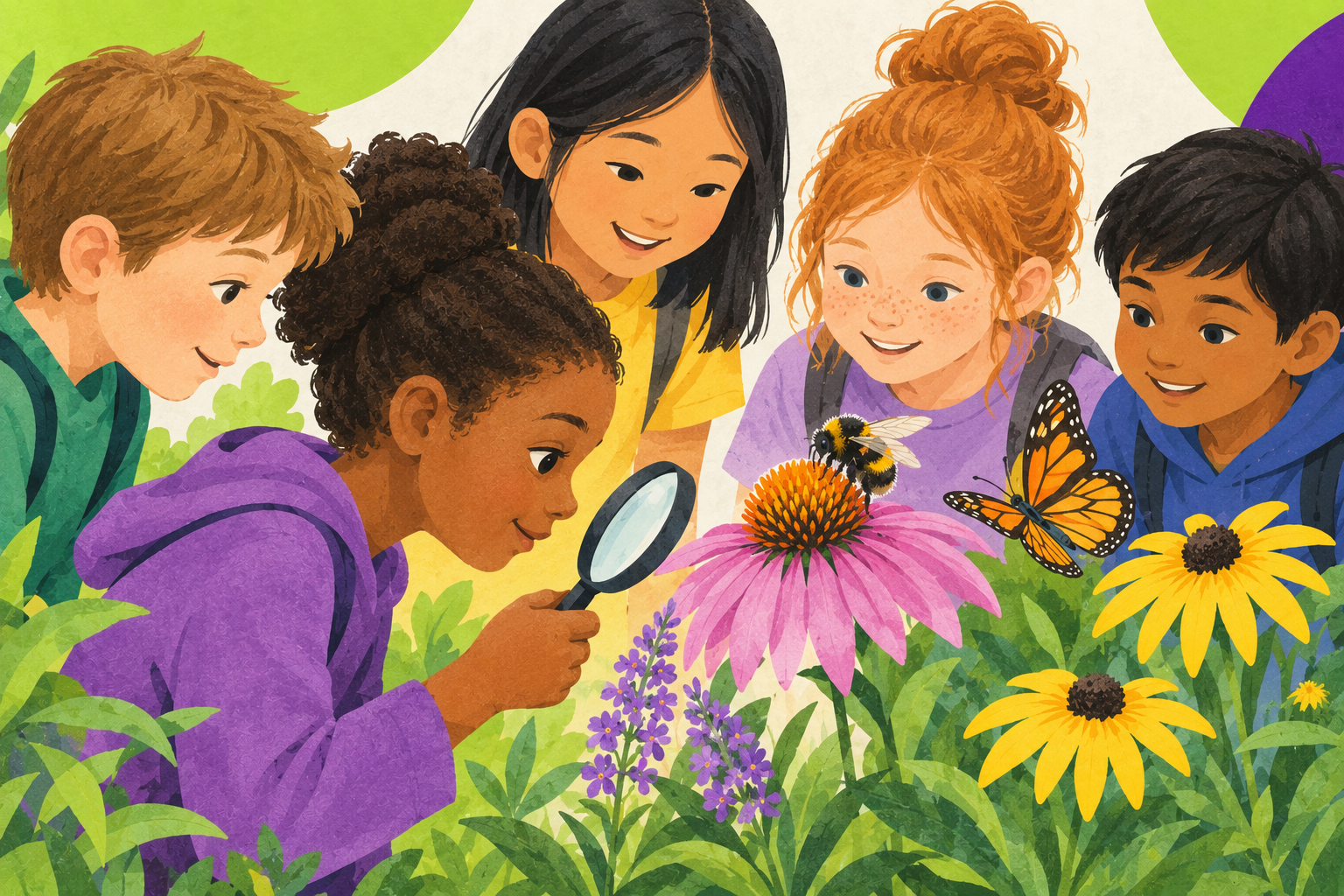
Much of what is being proposed reflects what BGEN members already know from their work with learners every day: understanding the natural world requires more than learning about it in a classroom. It comes from looking closely, asking questions, identifying organisms, noticing change, returning to places over time and beginning to understand the complex relationships between plants, animals, fungi, people and the environments around us.
The proposed content places considerable emphasis on exactly these skills. It includes classification and taxonomy, identification of plants, animals and fungi found in the UK, and fieldwork designed to develop students’ ability to investigate organisms in their habitats.
Will a Natural History GCSE find its place?
Of course, there is also some understandable scepticism within our sector about what happens next. Creating a Natural History GCSE is one thing; establishing it as a credible, accessible and widely taught qualification is another. There are legitimate questions about where Natural History will sit alongside well-established subjects such as Biology and Geography, both of which already contain significant ecological and environmental content. Will schools have the capacity, expertise and resources to offer another GCSE? How will it fit within an already challenging school timetable, where subject choices and option blocks can already feel like an elaborate game of Tetris? Will parents understand its value and support young people choosing it? And, crucially, will it be available across a genuinely diverse range of schools, or become a more specialist qualification concentrated in schools that already have the resources, confidence and access to outdoor learning needed to deliver it?
Comparisons have inevitably been made with other specialist GCSEs, including Astronomy, and there is a risk that Natural History could be perceived as an interesting but niche addition rather than a serious academic qualification. For BGEN, that makes it even more important that the subject is designed well from the outset, with rigorous content, meaningful fieldwork, clear progression routes and appropriate support for teachers and schools.
The success of the GCSE should ultimately be measured not simply by whether the qualification exists, but by who gets the opportunity to study it and what they gain from doing so. If Natural History is to fulfil its potential, it needs to be valued by schools, understood by parents and learners, and accessible to young people from a wide range of backgrounds and communities. Our sector has an important role to play in helping make that case – and in demonstrating that knowledge of the natural world is not a niche interest, but an increasingly important part of understanding the world in which young people are growing up.
Bringing the BGEN voice to the consultation
When the consultation opened, we wanted BGEN’s response to represent more than the views of the Board or one organisation. Our strength as a network lies in the collective knowledge and practical experience of our members. We therefore developed an initial BGEN assessment of the proposals and invited members to challenge it, support it and tell us what we had missed. The response was fantastic.
Across the consultation there was a remarkably strong degree of consensus. Members were overwhelmingly positive about the ambition behind the GCSE, while also bringing the detailed, practical insight that comes from working directly with plants, collections, landscapes, teachers and learners.
That feedback has directly shaped the response BGEN has now submitted to government.
Plants must have their place
One of our clearest messages concerns the role of plants.
We strongly welcome the explicit inclusion of plants alongside animals and other organisms within the aims of the qualification. Plants are not an optional extra in understanding natural history: they are fundamental to the structure and functioning of ecosystems. We welcome the use of the word wildlife to reflect flora, funga, and fauna – when it is usually associated to fauna alone.
However, we identified an important gap between that ambition and the detailed requirements.
Under the proposals, students would study four species within each habitat, but there is currently no guarantee that any of those four would be a plant. An awarding organisation could therefore legitimately select four animal species.
Our members were unanimous on this point.
BGEN has recommended that at least one of the four species studied within each habitat should be a plant. Without that requirement, we risk perpetuating the underrepresentation of plants within education and, more fundamentally, giving young people an incomplete understanding of how habitats actually work. Given low plant awareness and general plant apathy are ongoing trends in teachers and students, this oversight needs addressing to prevent the spiral continuing.
Members also encouraged greater recognition of other frequently overlooked organisms, including fungi, lichens and microorganisms.
Recognising the contribution of our sectorThe consultation also gives us an important opportunity to ensure that botanic gardens and arboreta are properly recognised within natural history education.
We were delighted to see museums, nature reserves, national parks, zoos and biodiversity records represented within the proposed content. But botanic gardens, arboreta, herbaria and living collections have an equally important story to tell.
Across the BGEN network, these places and collections support conservation, research, seed banking, propagation, restoration, taxonomy, education and public engagement. They also offer something particularly powerful for learners: the opportunity to encounter plants directly and to observe living organisms across seasons and lifecycles.
Our response therefore calls for botanic gardens and arboreta to be explicitly recognised as places contributing to conservation, and for herbaria and living collections to be recognised alongside museum collections and biodiversity records.
For BGEN members, this is about much more than recognition. As the GCSE progresses, our sector will have an important practical role in helping schools deliver it.
Getting young people outside
One of the strongest aspects of the proposed GCSE is its commitment to fieldwork, with 20 hours recommended as the minimum requirement.
BGEN members overwhelmingly welcomed this. We also strongly support the flexibility for schools to use school grounds, local green spaces and environments close to where students live.
Natural history should not leave young people believing that “nature” is something found only in a national park or nature reserve. Biodiversity exists in our gardens, streets, parks, ponds, allotments, school grounds and managed landscapes. Learning to notice and value the nature on our doorstep can be an important first step towards developing a lasting connection with it. Students don’t need to visit the Amazon to be amazed at the diversity of the plant kingdom.
Members also highlighted the challenge of turning an ambitious fieldwork requirement into consistently excellent experiences for students.
Teachers will need support. Schools will have very different access to habitats, expertise, time and resources. This is another area where botanic gardens, arboreta and environmental education organisations could become valuable partners – providing suitable environments, specialist knowledge, teacher training and development, and opportunities for fieldwork supported by experienced staff.
We have also encouraged opportunities for students to revisit places over time. Seeing the same habitat in autumn, winter, spring and summer can reveal something a single visit cannot: that nature is dynamic. Phenology, ecological change and the relationships between organisms become things students can actually observe rather than simply read about.
Making natural history accessible
Our members also brought considerable experience to the consultation’s questions around equality and accessibility. Getting more young people outside is a hugely positive ambition, but access to outdoor learning is not automatically equitable.
Inclusive fieldwork needs thoughtful planning: step-free routes, accessible toilets and changing place facilities, rest areas, accessible observation points and consideration of transport and mobility requirements. It also means thinking beyond physical access to sensory, cognitive and communication needs.
Sometimes the solution might be photography, audio recording or digital identification tools. Sometimes it might be a shorter visit, a visual narrative beforehand or a different way of taking part in a group activity. And often, the most important starting point is simply good communication.
Clear, personal conversations between schools, learners and fieldwork providers can take more time at the beginning, but they allow everyone to understand what to expect, what an individual learner needs and what adaptations might work. They help practitioners and students build relationships and give both the time and patience to learn from one another.
For us, equality should not mean requiring every learner to experience fieldwork in exactly the same way. It should mean giving every learner a meaningful opportunity to achieve the intended learning.
Again, many BGEN member organisations have enormous experience to contribute here.
Connecting with nature – responsibly
Perhaps one of the greatest opportunities presented by this GCSE is the potential to develop nature connectedness. Giving young people sustained opportunities to encounter, observe and understand the natural world can help create more ecologically literate and nature-aware citizens. The benefits of that can extend far beyond those who ultimately pursue careers in horticulture, botany, ecology or conservation.
But our members also reminded us that increased access to nature comes with responsibility. More people visiting sensitive environments can mean greater disturbance, trampling, damage to vegetation and the accidental movement of pests, diseases and invasive species.
Our response therefore argues that environmental responsibility should be taught as a core part of engaging with nature.
Students should learn not only how to investigate the natural world, but how to do so responsibly: minimising disturbance, respecting wildlife and habitats, recording and sampling appropriately and understanding biosecurity.
The answer to pressure on natural environments should not be to disconnect young people from them. It should be to give young people the knowledge, skills and respect they need to engage with them well.
Why BGEN’s collective voice matters
This consultation has been a useful reminder of why networks like BGEN matter.
Individually, our members hold an extraordinary breadth of expertise. Collectively, we can identify common challenges, share practical experience and speak with a stronger voice about the role botanical and environmental education should play nationally.
Our job as BGEN is not simply to tell members what is happening. It is to make sure that when decisions affecting our sector are being made, our members have an opportunity to influence them.
Thank you to every member who took the time to respond to our consultation. Your comments challenged our thinking, strengthened our recommendations and, importantly, gave us confidence that the response we have submitted genuinely represents the collective priorities of our network.
BGEN has now submitted that response to the Department for Education, but our advocacy does not stop with a consultation form. We will continue to follow the development of the Natural History GCSE, identify opportunities for our sector to contribute and advocate for the expertise, collections, landscapes and educational work represented across our membership.
There is a great deal still to be decided. But the prospect of a generation of young people being given dedicated time to look closely at nature, learn the names of the organisms around them, understand how habitats function and develop the confidence to investigate the natural world is something worth getting right.
And BGEN intends to make sure our sector has a voice in doing so.
The Department for Education consultation remains open until 4 September 2026. We strongly encourage BGEN member organisations to submit their own responses and add their voices to the consultation.