Why Are Plants Still Invisible? New Research Highlights the Importance of Plant Education
By Dr Lauren Daly, BGEN Chair

A new survey from the Royal Botanic Gardens, Kew, reveals a striking gap in public understanding of plants.
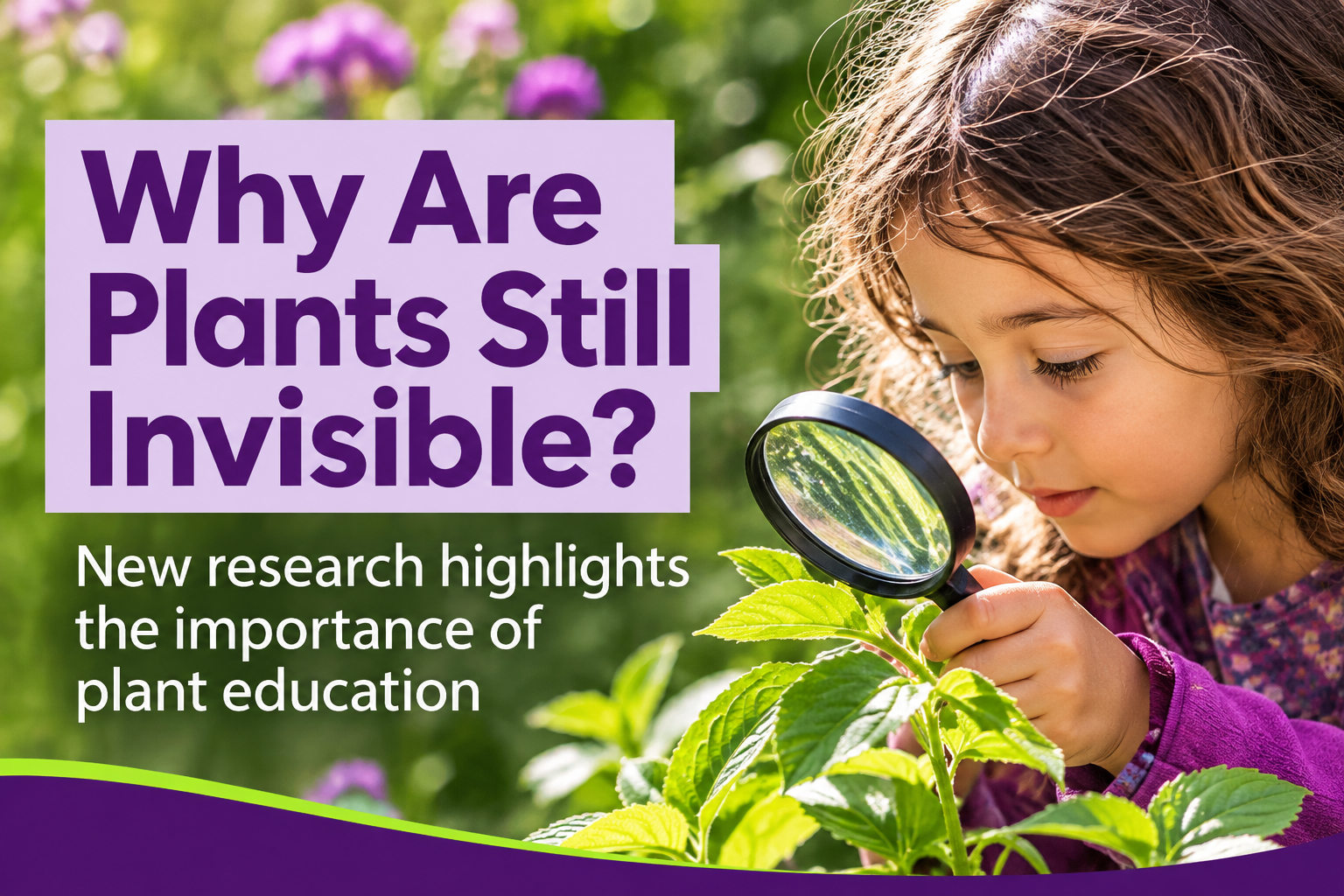
A new survey from the Royal Botanic Gardens, Kew, reveals a striking gap in public understanding of plants. Alongside research exploring how we investigate and foster plant awareness, the findings raise important questions for those working in botanic garden education: how do we help people not only understand plants, but truly notice and connect with them?
We depend on plants for almost every aspect of our lives, from the food we eat and the medicines we use to the ecosystems that sustain us. Yet despite their importance, plants are frequently overlooked in favour of more conspicuous wildlife.
New research commissioned by the Royal Botanic Gardens, Kew, suggests this remains a significant challenge. In a YouGov survey of more than 2,000 UK adults, 64% identified tropical rainforests as among the world’s most important habitats to protect. However, only 30% associated rainforests with medicines, while just 9% identified plant diversity as one of the most important factors affecting future food security.
When asked which organisms were most at risk of extinction, respondents overwhelmingly named familiar animals, including tigers, gorillas and elephants, with relatively few mentioning plants.
The findings, published by Kew in October 2026, highlight a disconnect between public concern for nature and recognition of the plants that underpin it.
For those working in plant education, this will sound familiar. But understanding why plants are overlooked, and what we can do about it, is more complicated than simply identifying gaps in people’s knowledge.
What does it mean to be plant aware?
The tendency to overlook plants has often been described as plant blindness, with plant awareness disparity or low plant awareness increasingly used as alternative, more inclusive terms. However, recent academic research suggests that we need to think more carefully about what plant awareness actually involves.
In an editorial published in the journal Plants, People, Planet, Methodologies for investigating and fostering plant awareness, Dawn Sanders, Peter Pany and Bethan Stagg explore the challenges of researching plant awareness and introduce a collection of studies investigating different approaches.
Their central argument is that plant awareness is complex, involving interconnected cognitive, emotional and behavioural dimensions. Recognising plant species, understanding their biology, noticing them in everyday surroundings and developing meaningful relationships with them are not necessarily the same thing.
The authors highlight weaknesses in how plant awareness has traditionally been investigated, particularly an over-reliance on questionnaires and self-reported measures. Without clearer definitions and more robust methods, it can be difficult to establish exactly what we are measuring, or whether educational approaches are making a difference.
They also call for greater collaboration across disciplines, including education, psychology, ethnobotany and the arts, recognising that different perspectives can reveal aspects of human–plant relationships that might otherwise remain hidden.
This is an important distinction. If plant awareness involves more than factual knowledge, then developing it may require more than simply providing information.
Beyond the usefulness of plants
There is an interesting tension between Kew’s findings and the questions raised by Sanders and colleagues.
Kew’s survey highlights how many people fail to recognise the practical importance of plants, particularly their contributions to medicines and food security. Helping people understand these connections is undoubtedly valuable.
However, Sanders and colleagues also draw attention to the risks of viewing plants primarily through their usefulness to humans. Drawing on earlier work by Sandra Knapp, they warn against a utility trap, where plants are valued mainly for what they provide rather than appreciated as living organisms in their own right.
Knowing that a plant produces a useful medicine does not necessarily mean someone will notice it growing nearby, become curious about its life or develop a lasting connection with it.
For educators, this raises a fundamental question: are we teaching people why plants matter to us, or are we also helping them appreciate plants for what they are?
Both have a place in plant education, but they may require different approaches.
New approaches to understanding and fostering plant awareness
The research collection introduced by Sanders and colleagues offers some thought-provoking examples of how plant awareness can be explored and developed.
Studies using student drawings and mind maps investigate how people understand and represent plants, revealing ideas, associations and emotional responses that conventional assessments may miss.
Other research explores the use of participatory art to investigate plant-related memories, demonstrating how plants can become connected with particular people, places and experiences.
Educational approaches involving herbaria offer opportunities for learners to engage directly with botanical processes, from selecting and identifying plants to collecting, pressing and documenting specimens. These activities bring together scientific understanding, observation and personal engagement.
What connects these different approaches is a recognition that plant awareness is not simply about acquiring more information. It can also involve attention, experience, emotion, memory and relationships.
For those working in botanic gardens, these ideas offer opportunities to reflect on both our educational practice and how we evaluate its impact.
What does this mean for botanic garden educators?
Botanic gardens are uniquely placed to help people develop deeper relationships with plants. Their living collections provide opportunities to encounter unfamiliar species, observe seasonal changes, explore ecological relationships and experience the extraordinary diversity of plant life.
Educators and interpreters already use a wide range of approaches to engage visitors, from scientific investigation and storytelling to art, sensory experiences and creative interpretation.
But the research encourages us to think critically about what we hope these experiences will achieve.
If a visitor leaves knowing the name of a plant, has their awareness increased? What if they remember its smell, notice something unusual about its growth, or begin paying closer attention to plants in their own neighbourhood?
These outcomes may all be valuable, but they are different. Understanding those differences could help us design more meaningful educational experiences and develop better ways of evaluating them.
It also challenges us to consider whose knowledge and experiences we recognise. People’s relationships with plants are shaped not only by scientific understanding, but also by culture, memory, identity and place. Making space for these perspectives may help us develop more inclusive and engaging approaches to plant education.
For BGEN, this is an important area for professional discussion. Our network brings together educators working in a wide variety of settings, each with different audiences, resources and opportunities. Sharing approaches, reflecting on practice and learning from emerging research can help us strengthen the impact of our work.
Ultimately, making plants more visible is not simply about telling people more about them. It is about creating opportunities for people to encounter plants differently, to become curious about their lives and to develop connections that extend beyond a single visit.
Continuing the conversation at BGEN Conference 2027
These questions will be particularly relevant at BGEN Conference 2027: Small Gardens, Big Impact, taking place on 26–27 January at the University of Leicester Botanic Garden.
We are delighted to welcome Dawn Sanders, from the University of Gothenburg, as our keynote speaker.
Her presentation, Revealing the Lives of Plants in Botanic Gardens: A place for art-based education and interpretation?, will explore how creative and artistic approaches can help us move beyond presenting plants as specimens or spectacles, instead revealing something of their lives, relationships and distinctive qualities.
It promises to be a fascinating opportunity to consider how botanic gardens can help visitors encounter plants in new ways, and what this might mean for the future of plant education and interpretation.
As Kew’s research reminds us, there is still much work to do in bringing plants into public awareness. The challenge for educators is not only to make plants more visible, but to consider what happens when people really begin to see them.
Join us at BGEN Conference 2027 to hear Dawn’s keynote, exchange ideas with colleagues and explore how gardens of every size can make a meaningful impact through plant education.